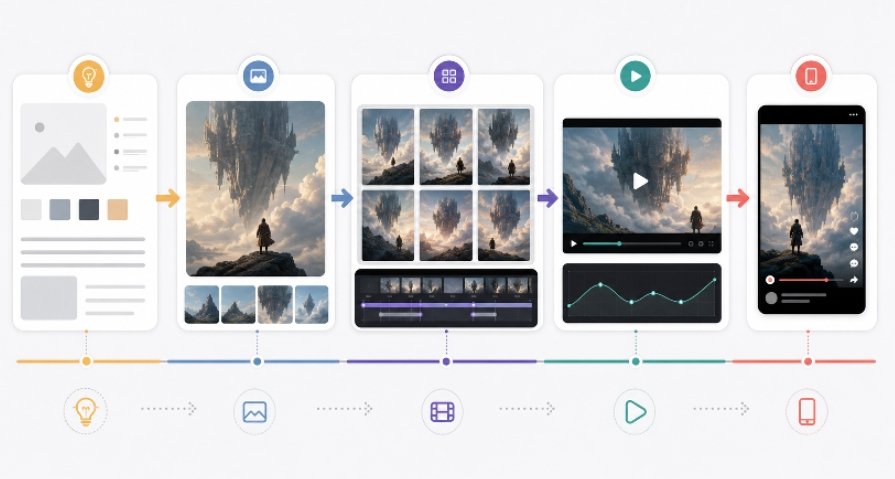
Short-form video has become one of the most demanding formats in digital marketing. It asks creators to move quickly, test multiple hooks, maintain visual quality, and publish across platforms that reward freshness. The challenge is not only making one good video. The challenge is building a repeatable workflow that can turn ideas into usable visual assets without exhausting a small team. That is where ImagineX becomes relevant: it represents an AI visual creation workflow for generating images, short videos, and visual variations from text and image inputs.
For many creators, the old production model is too heavy for early-stage experimentation. A full video shoot may require scripting, casting, locations, editing, music, review cycles, and revision time. That still matters for flagship campaigns, but it is often too slow for social testing, concept validation, product previews, and creator-led content. AI video tools are filling the gap between a rough idea and a production-ready direction.
The important shift is not that AI replaces video teams. It is that teams can now separate exploration from final production. They can sketch visual directions, test motion concepts, compare formats, and identify stronger ideas before committing expensive resources.
Why Video Creation Feels Harder Than Image Creation
AI image generation already changed the way people create campaign visuals, thumbnails, mood boards, and product concepts. Video adds another layer of complexity. A static image only needs to look coherent in one moment. A video needs continuity, pacing, motion, framing, and a reason for the viewer to keep watching.
That is why many AI video attempts fail even when the first frame looks good. The subject may drift. The motion may feel disconnected from the prompt. The visual style may change between frames. A clip may look impressive but fail to communicate the message. For marketing and creator workflows, that gap matters because a video is usually judged by clarity, not only visual polish.
A more practical approach starts with workflow design. Instead of asking an AI system to produce a finished commercial from one sentence, creators should move through a sequence: define the purpose, create visual anchors, generate motion, review continuity, and then refine for the platform.
The Role Of AI Video Generators In Modern Content Teams
AI video generators are most useful when they shorten the path from concept to review. They can help a team test a product scene, animate a static image, create a short social clip, explore a visual style, or produce multiple versions of the same idea for comparison.
This is especially useful for small teams. A founder can show a product concept in motion before commissioning a full shoot. A social media manager can test several intros for a launch post. A designer can turn a still visual into a moving storyboard. An educator can create quick visual explanations for abstract topics.
The strongest workflows combine AI speed with human judgment. A tool can generate options, but the creator still decides whether the clip supports the audience, brand, message, and platform.
Who Benefits Most From This Workflow
AI video workflows are especially useful for creators, marketers, founders, ecommerce teams, educators, and small studios that need more visual ideas than a traditional production schedule can support. They are well suited to early concepting, social media testing, previsualization, campaign drafts, motion backgrounds, and visual storytelling experiments.
They are less suitable when the final output needs exact product accuracy, regulated claims, celebrity likeness control, or fully polished broadcast quality. In those cases, AI can still support ideation, but final execution should involve professional editing and review.
The practical value is speed with structure. When teams combine clear briefs, visual anchors, controlled generation, and human review, AI video tools become more than novelty generators. They become a repeatable way to move from idea to visual direction faster.