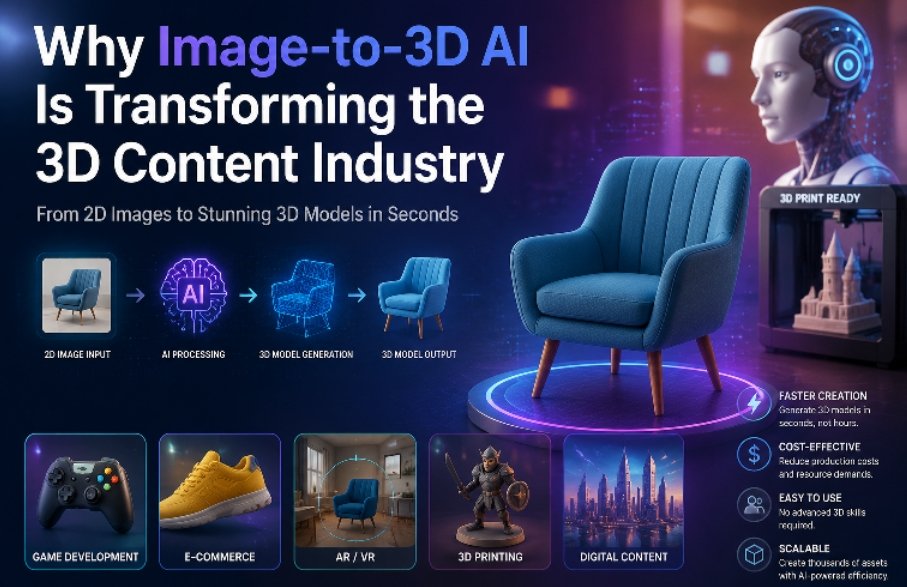
Image to 3D AI is rapidly reshaping how digital creators, studios, and businesses approach 3D content production. What once required specialized skills, expensive software, and hours (or even days) of manual modeling can now be initiated from something as simple as a single image. This shift is not just a technical upgrade—it represents a structural change in the 3D content industry itself. As demand for immersive experiences grows across gaming, e-commerce, AR/VR, and digital media, tools like image to 3D AI are becoming essential rather than optional. Even broader terms like image to 3D model AI are now widely used to describe this new generation of AI-driven pipelines that convert 2D visuals into usable 3D assets with minimal friction.
The Shift From Traditional 3D Modeling to AI-Driven Creation
For decades, 3D modeling has been a highly specialized discipline. Artists relied on tools like Blender, Maya, or 3ds Max, building models vertex by vertex or sculpting them in digital clay. While powerful, this workflow comes with a steep learning curve and significant time investment.
A single production-ready asset might take hours or even days to complete, especially when textures, topology, rigging, and optimization are required. This bottleneck has limited 3D content production primarily to studios and professionals.
The introduction of image to 3d model AI systems disrupts this entire workflow. Instead of starting from a blank scene, creators can now start with an image—concept art, product photos, sketches, or even screenshots—and let AI interpret depth, structure, and surface details automatically. This fundamentally lowers the barrier to entry and expands who can participate in 3D creation.
How Image-to-3D AI Works Behind the Scenes
At a high level, image-to-3D systems combine computer vision, deep learning, and generative modeling. While implementations vary, most modern pipelines follow a similar structure:
1. Image Understanding
The AI first analyzes the input image to detect objects, shapes, and spatial relationships. It identifies edges, contours, lighting cues, and semantic categories (for example: chair, character, product, etc.).
2. Depth Estimation
Since a single image is inherently 2D, the system must infer missing depth information. Neural networks estimate how far different parts of the object are from the camera, reconstructing a pseudo-3D structure.
3. Geometry Generation
Once depth is established, the system generates a mesh—often starting from a coarse structure and refining it iteratively. This step defines the actual 3D shape.
4. Texture Reconstruction
AI then projects or generates surface textures based on the original image. Advanced systems can extrapolate hidden surfaces that are not visible in the input.
5. Optimization & Export
Finally, the model is cleaned up for real-world use cases: reducing polygon count, fixing mesh issues, and exporting in formats like OBJ, GLB, or FBX.
This pipeline is what makes image to 3d AI systems so powerful—they automate what used to require multiple specialized roles.
Why Image-to-3D AI Is a Game Changer
The rise of image to 3d model AI tools is not just about convenience. It introduces several structural advantages that are reshaping production workflows across industries.
1. Speed of Creation
Traditional modeling is time-intensive. AI-driven generation reduces this process from hours to seconds or minutes. This allows creators to iterate faster and experiment more freely.
2. Lower Barrier to Entry
You no longer need to be a trained 3D artist to produce usable models. Designers, marketers, and indie developers can all participate in 3D creation.
3. Cost Efficiency
By reducing manual labor and outsourcing needs, businesses can significantly cut production costs while maintaining output quality.
4. Scalable Content Production
E-commerce platforms, game studios, and media companies can generate large libraries of assets quickly, enabling scalability that was previously impractical.
5. Creative Exploration
Instead of spending time on technical execution, creators can focus more on ideas, design direction, and storytelling.
Conclusion
The transformation brought by image to 3d AI is not just technological—it is cultural and industrial. It changes who can create 3D content, how fast it can be produced, and what workflows define modern digital production. While traditional modeling will continue to play an important role in high-end production, AI-driven systems are rapidly becoming the default starting point for most creators.
As tools become more accurate, accessible, and scalable, the influence of image to 3d AI will only continue to expand across industries, redefining what it means to build in three dimensions from a single image.
In this evolving landscape, image to 3d AI stands at the center of a new creative paradigm—one where imagination is no longer limited by technical barriers, but accelerated by intelligent systems.