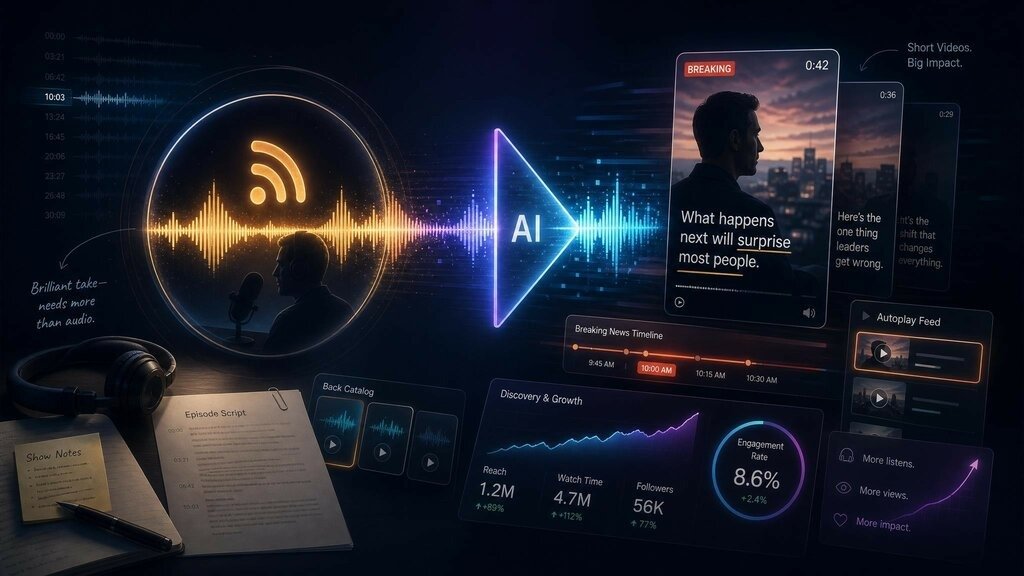
A host I follow covers her niche better than anyone — sharper sources, faster instincts, the relationships that get her the real story. When something breaks in her space, she’s recording a reaction within hours, and the segment is genuinely the best take available. It goes out as audio. A few hours later a faceless account takes a thinner version of the same story, cuts it into a sixty-second captioned clip, and owns the conversation on every feed where people actually discover new shows.
She wasn’t a worse analyst. She was just slower at one specific thing — turning a take into video — and on a timely story, slowness on video is a quiet, compounding tax.
Why Audio Loses the Discovery Race
It’s worth sitting with why this gap is so costly now.
Podcast discovery has always been the weak link. There’s no real search inside audio, no autoplay feed surfacing your episode to people who’ve never heard of you, no algorithm pushing a great forty-minute segment to a cold audience. Discovery moved to video — to the Shorts, Reels, and search results that decide who finds a show in the first place. Audio is where you deepen a relationship with the listeners you already have; video is increasingly how you get them.
Timely topics are where this stings most. A reaction to breaking news in your niche has a shelf life measured in hours, and that’s exactly the window in which producing a polished video has been impossible for most shows. The traditional path — script it for the screen, find footage, record on camera, edit, caption — costs days and real money. Fine for an evergreen feature; useless for a story that’s hot today and stale tomorrow. So podcasters do the rational thing and skip the clip, telling themselves the episode carries the weight.
Sometimes it does. But the deeper cost isn’t one missing video — it’s structural. Every breaking moment you cover brilliantly in audio but never turn into video is a recruitment channel left switched off. Across a year of news cycles, that’s hundreds of times you had the authoritative take in your space and stayed invisible exactly where new listeners were looking.
Turning the Take You Already Wrote Into a Clip
This is where a narrow category of tools has become genuinely useful for audio creators: platforms that turn a written script straight into a finished, narrated video, with no manual editing timeline. You paste the take you’ve already written — the show notes, the cold open, the briefing you prepped for the episode — and the AI builds a structured outline, generates the scenes and on-screen layout, and produces the voiceover, with an AI presenter fronting it if you want a face on camera.
Leadde.ai is one of these. For a podcaster, the point is turnaround: because the workflow starts from text you already wrote for the episode, the ability to generate news videos with AI means a clip becomes another output of the same prep, not a second production line you can’t staff. A same-day reaction can be a captioned video in one sitting.
Two features earn their place for timely audio content. Auto-generated captions, in a range of styles, are non-negotiable for the silent-autoplay feeds where short news clips are actually watched. And with support for 88 languages, a single take can be reissued for an international audience — translate a finished video into a new draft, script and on-screen text together — which matters for the global and cross-market listeners so many shows quietly serve.