If you’re running a podcast, you know the production grind. Write, record, re-record, edit, check for background noise, adjust levels, and finally publish. By the time your episode goes live, you’ve spent hours at the microphone. But what if AI text to speech could eliminate most of that work?
Meet the free AI text to speech —not the robotic voices from the ’90s, but sophisticated systems that generate audio so natural that listeners won’t realize they’re hearing artificial intelligence. For podcasters juggling multiple shows, tight deadlines, and vocal strain, AI text to speech is genuinely transformative.
The Real Problem Podcasters Face Today
Let’s be honest about podcast production. You’re investing significant time in recording, especially if you’re doing daily or multiple-weekly episodes. There’s the mental energy of being “on,” the physical toll on your voice, the editing nightmare of cleaning up audio, and then the pressure to publish consistently.
Many successful podcasters have reported experiencing throat fatigue, hoarseness, and vocal strain from constant recording. It’s a real occupational hazard. When you’re producing content at scale, you realize that traditional audio generation through your own voice becomes unsustainable.
Traditional solutions exist—hiring voice actors, using professional dubbing services, outsourcing voiceover work—but these come with hefty price tags ($100-500+ per session) and require days or weeks of turnaround time. Not practical when you’re trying to scale your podcast quickly.
This is where AI text to speech technology steps in as a game-changer.
Understanding Modern AI Text to Speech Technology
AI text to speech has experienced a dramatic evolution. Modern systems use deep learning to analyze text and generate speech that captures nuance, emotional undertone, and natural pacing. When you use AI text to speech tools today, you get audio that sounds authentically human.
The key innovation is that AI text to speech systems no longer just read words—they understand context. A sentence expressing sadness will be delivered differently than one expressing excitement through AI text to speech. Pauses appear naturally. Emphasis falls on appropriate syllables. This is what separates outdated computer voices from today’s sophisticated AI text to speech.
Best of all, quality AI text to speech tools are now available completely free online. No credit card, no sign-up process, no hidden fees. You can generate unlimited audio using AI text to speech without spending a dollar.
Why AI Text to Speech Matters for Creators and Podcasters
Time Savings That Actually Matter
Imagine cutting your episode production time from three hours to thirty minutes. That’s realistic when creators switch to AI text to speech for voiceovers. Your script becomes audio instantly through AI text to speech. No multiple takes. No extensive editing. Just immediate output ready to use.
For podcasters managing multiple shows, this multiplication effect compounds. A creator running five podcasts can now maintain all five simultaneously using AI text to speech, something previously impossible without a team of voice actors.
Consistency Your Audience Craves
Human voices fluctuate. You sound different when tired versus rested, sick versus healthy, morning versus evening. A listener’s subconscious notices these variations. AI text to speech eliminates this variable entirely. Every episode sounds identical in quality and tone through AI text to speech, which audiences actually find reassuring and professional.
Eliminating the Vocal Strain Problem
Stop damaging your voice for content. Whether you run a daily show or weekly series, let AI text to speech handle the heavy lifting on voiceovers. Your vocal cords—and your long-term health—will thank you. Many podcasters who switched to AI text to speech report immediate relief from vocal fatigue.
Global Reach Without Global Effort
Want international listeners? Generate your podcast content in Spanish, French, German, Mandarin, or 15+ other languages using AI text to speech. What used to require hiring separate voice actors for each language now takes minutes with AI text to speech. Each version sounds professional and natural.
Freedom to Focus on What Matters
When production logistics no longer consume half your time, you can focus on creating better content. AI text to speech handles the mechanical parts; you handle the creative parts. This shift in focus typically results in higher-quality episodes overall.
How to Use AI Text to Speech: Step-by-Step
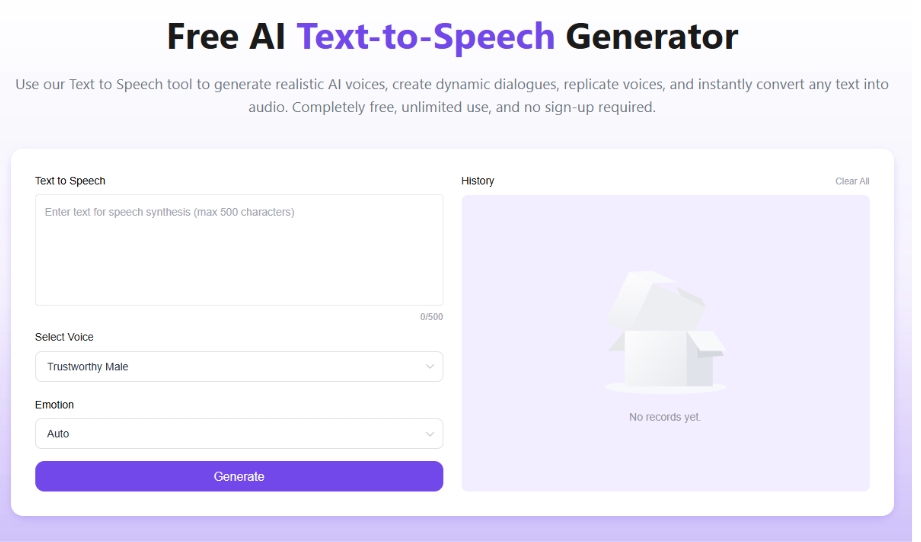
Getting started with AI text to speech is refreshingly simple. No learning curve required.
Step One: Prepare Your Text
Write your podcast script, interview transcript, or promotional message and paste it into the AI text to speech interface. Any language works—the system auto-detects what you input. You can generate audio for anything from 100 words to 10,000+ words using AI text to speech.
Step Two: Choose Your Voice and Tone
This is where personalization in AI text to speech happens. You’ll see dozens of voice options—different genders, ages, accents, and character types. More importantly, you can choose emotional tone when using AI text to speech: happy, neutral, serious, calm, or other variations. Pick the combination that matches your content’s personality.
Step Three: Generate and Download
Click the button in your AI text to speech tool, wait seconds for processing, and your audio is ready. Preview it first. If something doesn’t sound right with your AI text to speech output, regenerate with different settings. Once satisfied, download in MP3 or your preferred format.
That’s it. Three straightforward steps with AI text to speech. No technical skills required.
Practical Applications for Different Podcast Types
Solo shows and commentary podcasts benefit most immediately from AI text to speech. Instead of recording yourself daily, generate episodes in minutes using AI text to speech. Maintain your show’s personality through voice selection while gaining massive time savings.
Interview-based shows can use AI text to speech for intros, outros, and transition segments while keeping guest conversations recorded naturally. This hybrid approach with AI text to speech preserves authenticity where it matters most while automating the mechanical parts.
Multilingual shows become feasible for solo creators with AI text to speech. Record your episode once in English, then generate professional versions in Spanish, French, German, and other languages using AI text to speech. You’re now serving multiple markets simultaneously.
Audiobook narration projects that podcasters sometimes undertake become dramatically faster with AI text to speech. Converting long-form content into professional-sounding audio through AI text to speech happens instantly rather than requiring weeks of studio time.
Podcast network operations with dozens of shows can maintain consistent publishing schedules using AI text to speech at a fraction of traditional voiceover costs. Quality stays high; overhead disappears.
Real Results from Creators Using AI Text to Speech
A daily news podcast that previously spent three hours daily on voiceover production now publishes episodes in twenty minutes using AI text to speech. Listener engagement actually improved because the host could focus on editorial quality rather than vocal performance.
One multi-podcast operator managing five shows while working part-time found this impossible before discovering AI text to speech. Now maintaining multiple podcasts is routine.
Marketing professionals use AI text to speech for podcast advertisements and sponsorships, creating multiple variations in different emotional tones without booking studio time. The flexibility of AI text to speech means less back-and-forth with voice actors.
Educational content creators producing course material discovered that podcast-style narration through AI text to speech of written lessons increased student engagement—and they could generate complete audio for a course in hours rather than weeks.
The Comparison That Matters
When you stack AI text to speech against traditional voiceover options, the advantage becomes clear:
- Speed: Minutes with AI text to speech versus days or weeks traditionally
- Cost: Free AI text to speech versus $100-500+ per session
- Flexibility: Unlimited regenerations with AI text to speech versus locked recorded takes
- Consistency: Identical output every time with AI text to speech versus human variation
- Languages: Instant generation with AI text to speech versus hiring new talent per language
- Commercial Rights: Full usage rights with AI text to speech included, no licensing concerns
The economics and practicality favor AI text to speech overwhelmingly.
Getting Started: Your AI Text to Speech Implementation Path
Week One: Try AI text to speech with your most recent podcast script. Test different voices and emotional tones. Notice which voice combination feels authentic to your show’s personality when using AI text to speech.
Week Two: Generate a complete episode using your selected AI text to speech settings. Share it with trusted listeners. Ask for honest feedback about whether they perceive it as AI text to speech or human narration. (You’ll probably be surprised—most won’t notice.)
Week Three: Run a small test. Generate voiceovers for half your regular content using AI text to speech, keep your voice for the other half. Monitor metrics. Compare listener retention and engagement between AI text to speech and traditional voiceovers.
Week Four: Make a decision based on data. If metrics hold or improve with AI text to speech, consider scaling. If you prefer traditional recording, at least you’ve tested whether AI text to speech works for your audience.
The Future of Podcast Production With AI Text to Speech
AI text to speech technology has reached the inflection point where it’s genuinely useful rather than gimmicky. The quality is professional. The process is simple. The economics are compelling.
This isn’t about replacing podcast hosts or eliminating authentic human connection. It’s about automating the parts that drain your time and voice without adding value. Your listeners care about content quality and consistency. They don’t care whether your voiceovers came from your vocal cords or from AI text to speech that sounds identical.
For podcasters overwhelmed by production demands, struggling with vocal strain, or simply wanting to launch more content faster, AI text to speech deserves serious consideration. The barrier to entry is literally zero—just visit a free AI text to speech service and try it today.
Your future self, with more free time and a healthier voice, will appreciate deciding to explore AI text to speech.